Indian Institute of Technology Madras
BS Degree Programme · Examination & Study Paper
BSMA1001 · Mathematics for Data Science I
Relations & functions basics
Examination Instructions & Guidelines
- Solve on notebook/paper first before checking solutions.
- MCQ: Exactly 1 option is correct. Negative marking applies.
- MSQ: One or more options correct. Select all to score.
- NAT: Numerical response. No negative marking.
- Scientific calculator allowed for all calculations.
- Official answer key is sealed at the end of this sheet.
Quiz 1 · 26 Oct 2025 (AN)Quiz 1
Useful Reference Data for this Paper
 Q1MSQ4 Marks·Choose all correct options
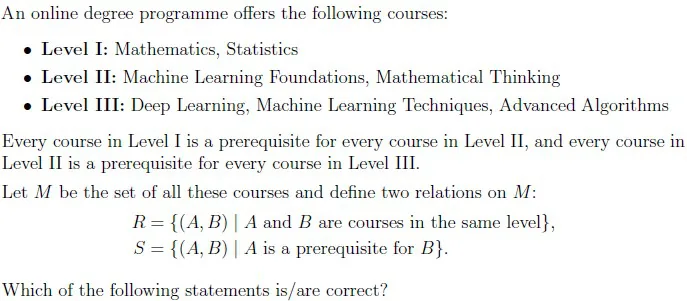
- AR is an equivalence relation.
- BS is an equivalence relation.
- CR is not transitive.
- DS is not symmetric.
- Q2NAT4 Marks·Write the number
 Your answer:
End Term · 31 Aug 2025 (FN)End Term
- Q3MSQ3 Marks·Choose all correct options
Which of the following options is / are true ?
- A

- B

- C

- D

- A
End Term · 22 Dec 2024 (FN)End Term
- Q4MSQ4 Marks·Choose all correct options
- A

- B

- C

- D

- A
Qualifier · May 2024Qualifier
Read the passage below, then answer Q5–Q7
 Q5NAT3 Marks·Write the number
 Your answer:
- Q6NAT2 Marks·Write the number
What is the cardinality of R₁?
Your answer: - Q7MSQ3 Marks·Choose all correct options
Which of the following statements are correct?
- AR₁ is transitive.
- BR₂ is transitive.
- CR₂ is not symmetric.
- D(2,18) is an element in R₂.
Qualifier · January 2024Qualifier
- Q8MSQ5 Marks·Choose all correct options
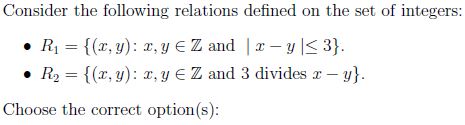
- A

- B

- C

- D

- A
Qualifier · September 2023Qualifier
- Q9MSQ4 Marks·Choose all correct options
Which of the following options is/are true?
- A

- B

- C

- D

- A
Read the passage below, then answer Q10–Q11
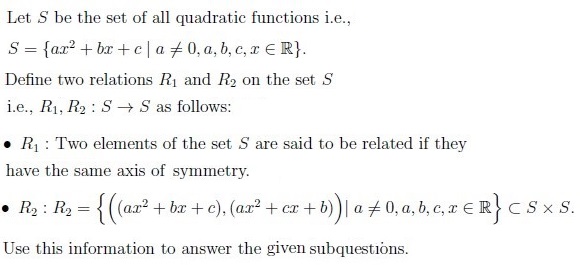 Q10MSQ4 Marks·Choose all correct options
Which of the following options is/are true?
- AR₁ is a reflexive relation.
- BR₂ is a symmetric relation.
- CR₁ is not a transitive relation.
- DR₂ is a transitive relation.
- Q11MCQ4 Marks·Choose one option
Which of the following options is true?
- AR₁ is a function.
- BR₂ is a function.
- CR₂ is not a one-one function.
- DR₂ is not an onto function.
Qualifier · May 2023Qualifier
Read the passage below, then answer Q12–Q14
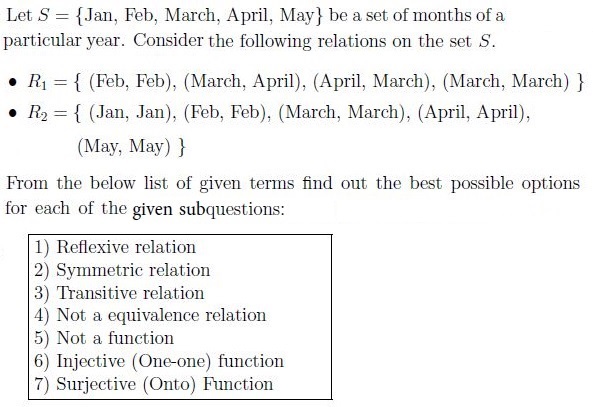 Q12NAT3 Marks·Write the number
R₁ is _____________ . (Enter all correct options. Enter only the serial numbers of those options in increasing order without adding any comma or space in between them i.e., if your answer is 6 and 7, then you should enter 67]
Your answer:- Q13NAT3 Marks·Write the number
R₂ is ____________ . (Enter all correct options. Enter only the serial numbers of those options in increasing order without adding any comma or space in between them i.e., if your answer is 3 and 4, then you should enter 34)
Your answer: - Q14NAT2 Marks·Write the number
Find the cardinality of the set (S × S) \ R₂.
Your answer:
Qualifier · January 2023Qualifier
- Q15MSQ5 Marks·Choose all correct options
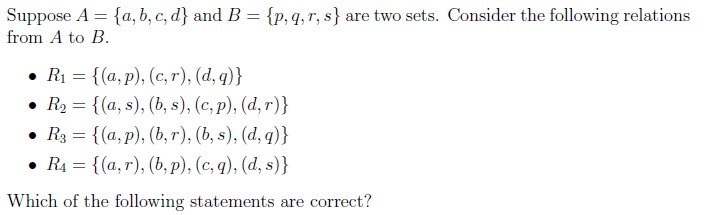
- AR₂,R₃, and R₄ are functions
- BR₂ and R₄ are functions
- CR₂ is an injective function
- DR₄ is a bijective function
Official KeyMaster Answer Key & Explanations
Official answer keys from IIT Madras BS past papers. Click any question to review.
Reveal KeyCollapse Key
Master Answer Key & Explanations
Official answer keys from IIT Madras BS past papers. Click any question to review.
Detailed Answer Notes & Working
- Q5Answer: 1
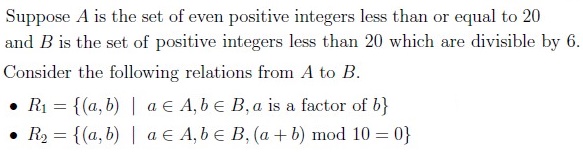
- A = {2, 4, …, 20} and B = {6, 12, 18}. R₂ needs a + b to end in 0, so R₂ = {(4,6), (14,6), (8,12), (18,12), (2,18), (12,18)}. Of these, only (2,18) has a as a factor of b. So R₁ ∩ R₂ = {(2,18)} and its cardinality is 1.
- Q6Answer: 9
- B = {6, 12, 18}. For b = 6, a can be 2 or 6. For b = 12, a can be 2, 4, 6 or 12. For b = 18, a can be 2, 6 or 18. So |R₁| = 2 + 4 + 3 = 9.
- Q7Answer: A, C, D
- Being a factor is transitive (a divides b and b divides c means a divides c), so R₁ is transitive. R₂ = {(4,6), (14,6), (8,12), (18,12), (2,18), (12,18)}. (2,18) and (18,12) are in R₂ but (2,12) is not, so R₂ is not transitive. (4,6) is in R₂ but (6,4) is not, so R₂ is not symmetric. 2 + 18 = 20, so (2,18) ∈ R₂.
- Q8Answer: A, D
- R₁ is reflexive (|x − x| = 0) and symmetric (|x − y| = |y − x|). It is not transitive: (0,3) and (3,6) are in R₁ but |0 − 6| = 6 > 3. R₂ means x and y leave the same remainder on division by 3, which is reflexive, symmetric and transitive. So R₂ is an equivalence relation and R₁ is not.
- Q9Answer: B, C
- |S × S| = 4 × 4 = 16, not 4. y − 1 = (x − 2)² is y = (x − 2)² + 1, so the vertex is (2, 1). Any subset of S × S is a relation on S by definition. A line parallel to the y-axis is vertical, so its slope is undefined, not 0.
- Q10Answer: A, B
- R₁ means same axis of symmetry, which works like equality, so R₁ is reflexive, symmetric and transitive. R₂ swaps b and c, and swapping again gives the first function back, so R₂ is symmetric. R₂ is not transitive: f R₂ g and g R₂ f, but f R₂ f only when b = c.
- Q11Answer: B
- R₂ sends each ax² + bx + c to exactly one function, ax² + cx + b, so R₂ is a function. It is one-one and onto, because swapping b and c again undoes it. R₁ is not a function: one quadratic has the same axis as many others.
- Q12Answer: 245
- R₁ is not reflexive (Jan is missing). It is symmetric. It is not transitive: (April, March) and (March, April) are in R₁ but (April, April) is not, so it is not an equivalence relation. It is not a function, since March has two images and Jan has none. Options 2, 4, 5, so enter 245.
- Q13Answer: 12367
- R₂ is the identity relation on S. It is reflexive, symmetric and transitive, so it is an equivalence relation. Each month maps to itself, so it is a function that is both one-one and onto. Options 1, 2, 3, 6, 7, so enter 12367.
- Q14Answer: 20
- |S × S| = 5 × 5 = 25. R₂ is the identity relation with 5 pairs, all inside S × S. So the set (S × S) minus R₂ has 25 − 5 = 20 elements.
- Q15Answer: B, D
- R₁ is not a function (b has no image). R₃ is not a function (b has two images, r and s). R₂ is a function but not injective, since a and b both go to s. R₄ sends a, b, c, d to r, p, q, s, all different and covering B, so it is a bijection.