Indian Institute of Technology Madras
BS Degree Programme · Examination & Study Paper
BSMA1001 · Mathematics for Data Science I
Polynomials & their graphs
Examination Instructions & Guidelines
- Solve on notebook/paper first before checking solutions.
- MCQ: Exactly 1 option is correct. Negative marking applies.
- MSQ: One or more options correct. Select all to score.
- NAT: Numerical response. No negative marking.
- Scientific calculator allowed for all calculations.
- Official answer key is sealed at the end of this sheet.
Quiz 1 · 26 Oct 2025 (AN)Quiz 1
Useful Reference Data for this Paper
 Q1MCQ4 Marks·Choose one option

- A

- B

- C

- D

- A
- Q2MSQ4 Marks·Choose all correct options

- A

- B

- C

- D

- A
- Q3NAT5 Marks·Write the number
 Your answer:
End Term · 22 Dec 2024 (FN)End Term
Read the passage below, then answer Q4–Q5
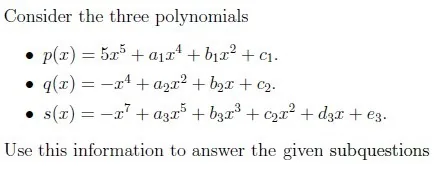 Q4MCQ3 Marks·Choose one option
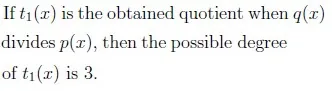
Which of the following options is/are true?
- A
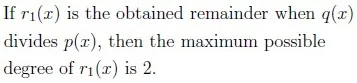
- B
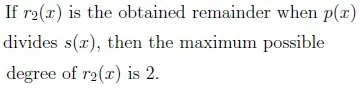
- C
- D
- A
- Q5MCQ3 Marks·Choose one option
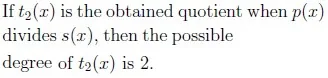
Which of the following option is true?
- A

- B

- C

- D

- A
Qualifier · May 2024Qualifier
- Q6MSQ4 Marks·Choose all correct options
Consider the following polynomial p(x) whose graph is given below:-
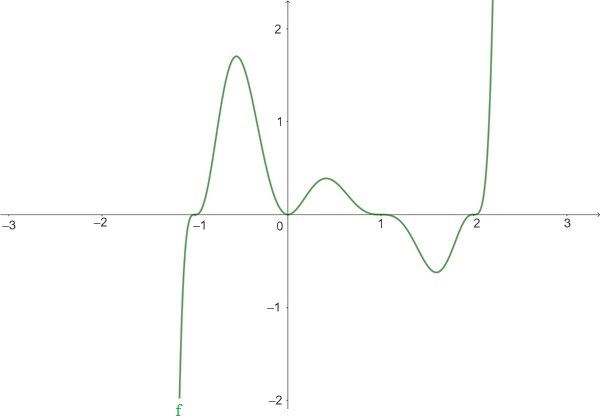 Which of the following options is/are correct?
- A

- B

- C

- D

- A
- Q7MSQ4 Marks·Choose all correct options

- Aq(x) is a cubic polynomial.
- Bq(x) is a quadratic polynomial.
- Cq(x) has two distinct zeros.
- Dq(x) does not have any real zeros.
Qualifier · January 2024Qualifier
- Q8MSQ5 Marks·Choose all correct options

- A

- B

- C

- D

- A
- Q9MSQ4 Marks·Choose all correct options
Consider the following polynomial p(x) whose graph is given below:-
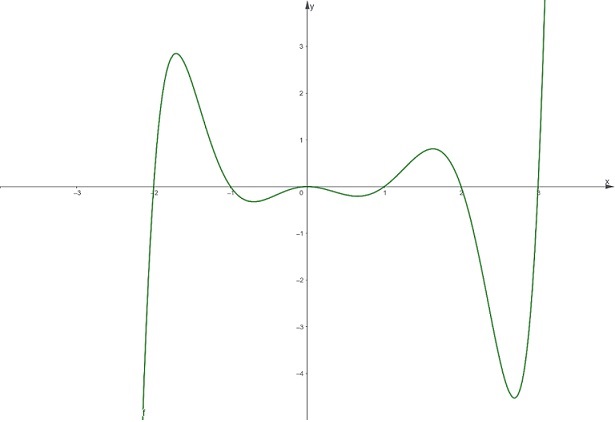 Which of the following options is/are correct.
- AMultiplicity of -1 and 1 must be same.
- Bp(x) is increasing in the interval (3,∞).
- CThe total number of local minima is 3.
- DThe number of turning points is 5.
Qualifier · September 2023Qualifier
- Q10MSQ4 Marks·Choose all correct options
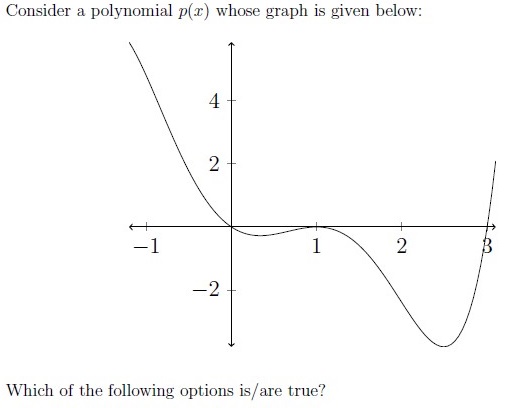
- A

- B

- C

- D

- A
Read the passage below, then answer Q11–Q12
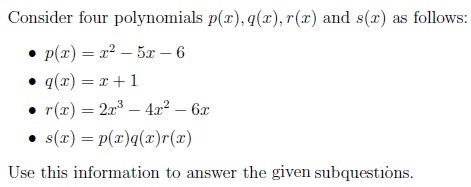 Q11MSQ3 Marks·Choose all correct options
Which of the following options is/are true?
- A

- B

- C
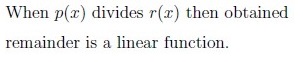
- D

- A
- Q12MSQ4 Marks·Choose all correct options
Which of the following options is/are true?
- A

- B

- C

- D

- A
Qualifier · May 2023Qualifier
- Q13MCQ5 Marks·Choose one option

- A
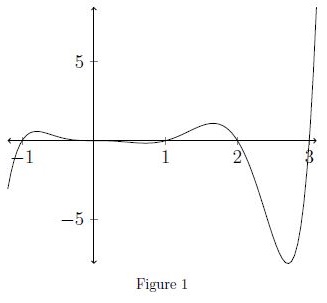
- B
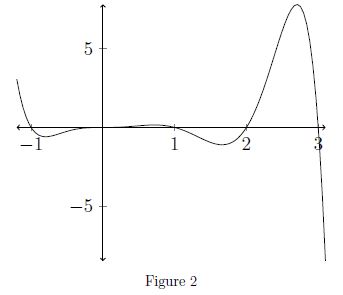
- C
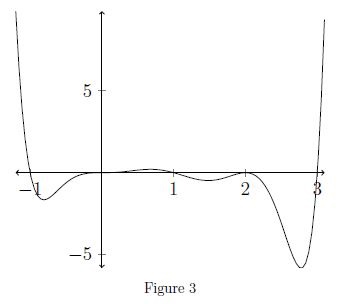
- D
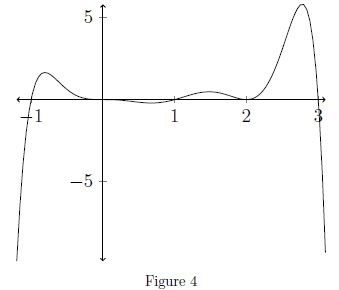
- A
- Q14MSQ5 Marks·Choose all correct options
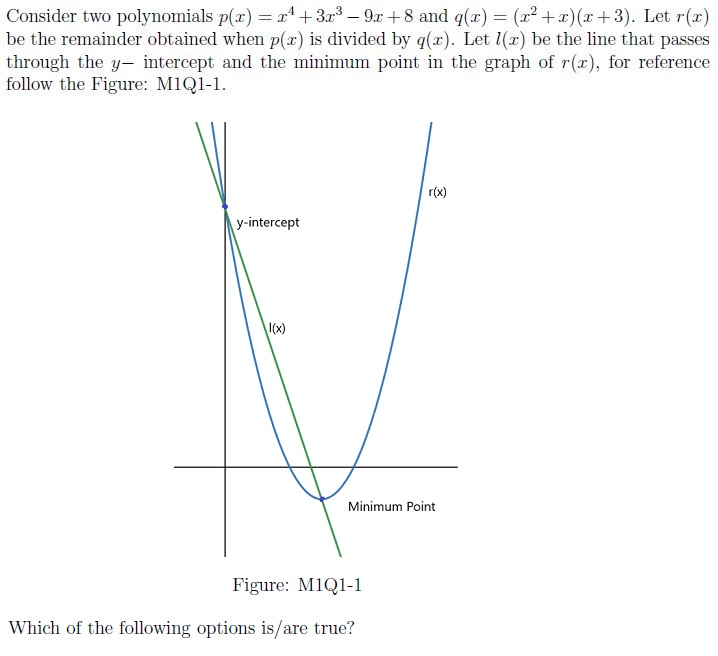
- A

- B

- C

- D

- A
Read the passage below, then answer Q15–Q16
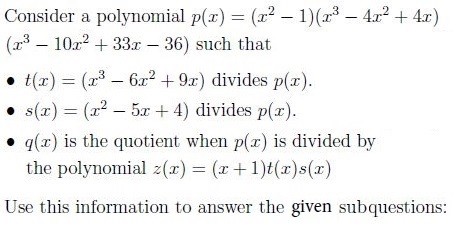 Q15NAT3 Marks·Write the number
If m is the number of distinct roots and n is the number of turning points of the polynomial p(x), then find the value of m + n
Your answer:- Q16MSQ4 Marks·Choose all correct options
Which of the following options is/are true?
- A

- B

- C

- D

- A
Qualifier · January 2023Qualifier
- Q17MSQ5 Marks·Choose all correct options
Rubika launches her new company in the year 2010, which makes a yearly profit in lakhs as the polynomial function p(x) = 0.1x² (x − 1) (x − 2) (x − 3)² (x − 4) (x − 9) for the first 12 years since the launch, where x is the number of years since 2010 (i.e., x = 0 denotes the year 2010, x = 1 denotes the year 2011, and so on). Let the loss be represented as −ve of profit. Which of the following options are correct?
- AIncluding the year in which the company was launched, it neither made a profit nor a loss six times in 12 years.
- BThe company made profit in years x ∈ {7, 8, 10, 11}.
- CThe company made loss (−ve profit) in years x ∈ {5, 6, 7, 8}.
- DIn the year 2022 (i.e., x = 12) the company made profit.
- Q18MSQ5 Marks·Choose all correct options
Figure 2 shows the graph of a polynomial p(x). Choose the set of correct option(s).
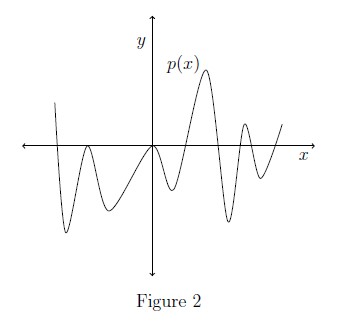
- AThe degree of p(x) is at least 10.
- Bp(x) represent an even degree polynomial.
- CTotal number of turning point of p(x) are 8.
- DMultiplicities of zero and one of the negative roots could be the same.
- Q19MSQ6 Marks·Choose all correct options
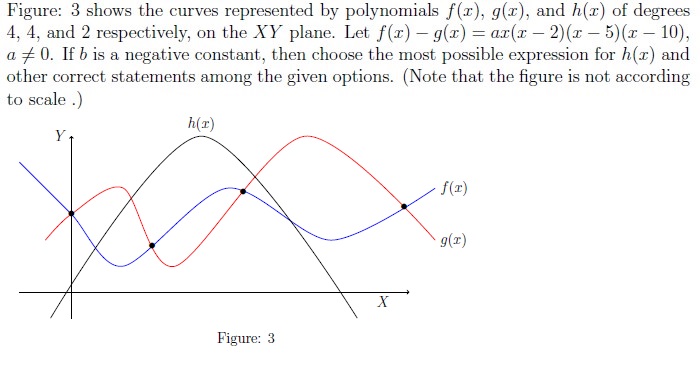
- A

- B

- C

- D

- A
Official KeyMaster Answer Key & Explanations
Official answer keys from IIT Madras BS past papers. Click any question to review.
Reveal KeyCollapse Key
Master Answer Key & Explanations
Official answer keys from IIT Madras BS past papers. Click any question to review.
Detailed Answer Notes & Working
- Q6Answer: B, C
- The graph crosses at −1, 1 and 2 with a flat shape, so these roots have odd multiplicity (3 or more), but they need not be equal. After x = 2 the graph goes up forever, so p(x) is increasing on (2, ∞) and p(x) → ∞ as x → ∞. There are only 4 turning points, not 5.
- Q7Answer: B, C
- The zeros 1/2 and 5 come from (2x − 1)(x − 5). The other zeros 2 and 3/5 must come from q(x). So q(x) = k(x − 2)(5x − 3), which is a quadratic with two distinct real zeros.
- Q8Answer: B, C, D
- Both p and q have degree 5 with leading coefficient −1. So p(x) → −∞ and q(x) → −∞ as x → ∞. A degree 5 polynomial has at most 4 turning points. Since the degrees and leading terms match, q(x) ÷ p(x) gives the constant quotient 1.
- Q9Answer: B, C
- The roots are −2, −1, 0, 1, 2 and 3, and the graph rises after x = 3, so p is increasing on (3, ∞). The local minima are near −0.6, 0.6 and 2.7, so there are 3. There are 6 turning points, not 5. The roots −1 and 1 only need odd multiplicity, so they need not be the same.
- Q10Answer: A, D
- The graph crosses the axis at 0 and 3 and touches it at 1, so root 1 has even multiplicity. Minimum degree = 1 + 2 + 1 = 4, and root 3 can have multiplicity 1. The graph crosses at x = 0, so there is no turning point there. There are 3 turning points, not 4.
- Q11Answer: B, C
- p(x) + q(x) = x² − 4x − 5 has degree 2. p(x)r(x) has degree 2 + 3 = 5. Dividing r(x) = 2x³ − 4x² − 6x by p(x) = x² − 5x − 6 gives quotient 2x + 6 and remainder 36x + 36, which is linear.
- Q12Answer: B, D
- p(x) = (x − 6)(x + 1), q(x) = x + 1, r(x) = 2x(x − 3)(x + 1). So s(x) = 2x(x + 1)³(x − 3)(x − 6). The distinct roots are −1, 0, 3, 6 (four), root 3 has multiplicity 1, and 1 is not a root. There is one turning point in each gap (−1,0), (0,3), (3,6), so 3 turning points.
- Q13Answer: C
- p(x) = 0.3x³(x − 1)(x + 1)(x − 2)²(x − 3) has degree 3 + 1 + 1 + 2 + 1 = 8 with a positive leading term. So both ends go up to +∞. Only Figure 3 has both ends up, and it also touches the axis at x = 2 (even multiplicity).
- Q14Answer: B, D
- q(x) = x³ + 4x² + 3x. Dividing p(x) by q(x) gives quotient x − 1 and remainder r(x) = x² − 6x + 8. Its y-intercept is (0, 8) and its minimum point is (3, −1), so l has slope (−1 − 8)/3 = −3 and l is y = −3x + 8. q(x) = x(x + 1)(x + 3) has 3 distinct roots, so 2 turning points.
- Q15Answer: 13
- x³ − 4x² + 4x = x(x − 2)² and x³ − 10x² + 33x − 36 = (x − 3)²(x − 4). So p(x) = x(x − 1)(x + 1)(x − 2)²(x − 3)²(x − 4). Distinct roots: −1, 0, 1, 2, 3, 4, so m = 6. There is one turning point in each of the 5 gaps between roots, plus one at each touching root 2 and 3, so n = 7. m + n = 13.
- Q16Answer: A, C, D
- p(x) = x(x − 1)(x + 1)(x − 2)²(x − 3)²(x − 4) has degree 8 (even) with a positive leading term, so p(x) → +∞ at both ends. z(x) = x(x + 1)(x − 1)(x − 3)²(x − 4), so q(x) = p(x)/z(x) = (x − 2)², whose minimum value is 0.
- Q17Answer: A, C, D
- p(x) = 0 at x = 0, 1, 2, 3, 4, 9, so six years with no profit or loss. x² and (x − 3)² are never negative, so the sign comes from (x − 1)(x − 2)(x − 4)(x − 9). For x = 5 to 8 this is negative (loss), so option B is false. For x = 12 all factors are positive, so there is profit.
- Q18Answer: A, B, D
- Reading the graph from left to right there are 9 turning points, not 8, so the degree is at least 10. Both ends go up, so the degree is even. The root at 0 and the negative root where the graph touches the axis both have even multiplicity, so they can be equal.
- Q19Answer: C, D
- f(x) − g(x) = ax(x − 2)(x − 5)(x − 10) is zero at x = 0, 2, 5, 10, so f = g there. h has degree 2 and b < 0, so it opens downward. In the figure h has one root just left of 0, one positive root and its vertex at positive x. b(x² − 6x − 7) = b(x + 1)(x − 7) fits; b(x² + 8x − 7) has its vertex at x = −4.