Indian Institute of Technology Madras
BS Degree Programme · Examination & Study Paper
BSMA1001 · Mathematics for Data Science I
Qualifier · September 2023
Examination Instructions & Guidelines
- Solve on notebook/paper first before checking solutions.
- MCQ: Exactly 1 option is correct. Negative marking applies.
- MSQ: One or more options correct. Select all to score.
- NAT: Numerical response. No negative marking.
- Scientific calculator allowed for all calculations.
- Official answer key is sealed at the end of this sheet.
Read the passage below, then answer Q1–Q2
In a survey among 140 people, it was found that 75% of these 140 people like playing cricket and 50% of all the 140 people like playing football. Note that, some people may not like both games that could be 0 also.
Use this information to answer the given subquestions
Q1NAT4 Marks·Write the numberWhat is the minimum number of people who like both games?
Your answer:- Q2NAT2 Marks·Write the number
If there are 10 people who don’t like both games, then what is the number of people who like only cricket?
Your answer: - Q3MCQ4 Marks·Choose one option

- A

- B

- C

- D

- A
- Q4MCQ4 Marks·Choose one option

- A

- B

- C

- D

- A
- Q5MCQ3 Marks·Choose one option
- A

- B

- C

- D

- A
- Q6NAT4 Marks·Write the number
 Your answer:
- Q7MSQ4 Marks·Choose all correct options
- A

- B

- C

- D

- A
- Q8MSQ4 Marks·Choose all correct options
Which of the following options is/are true?
- A

- B

- C

- D

- A
Read the passage below, then answer Q9–Q10
 Q9MSQ3 Marks·Choose all correct options
Which of the following options is/are true?
- A

- B

- C
- D

- A
- Q10MSQ4 Marks·Choose all correct options
Which of the following options is/are true?
- A

- B

- C

- D

- A
Read the passage below, then answer Q11–Q12
 Q11MCQ3 Marks·Choose one option
Which of the following options is true?
- A

- B

- C

- D

- A
- Q12NAT3 Marks·Write the number
 Your answer:
Read the passage below, then answer Q13–Q14
 Q13MSQ4 Marks·Choose all correct options
Which of the following options is/are true?
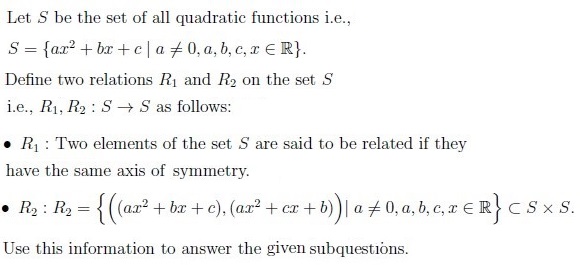
- AR₁ is a reflexive relation.
- BR₂ is a symmetric relation.
- CR₁ is not a transitive relation.
- DR₂ is a transitive relation.
- Q14MCQ4 Marks·Choose one option
Which of the following options is true?
- AR₁ is a function.
- BR₂ is a function.
- CR₂ is not a one-one function.
- DR₂ is not an onto function.
Official KeyMaster Answer Key & Explanations
Official answer keys from IIT Madras BS past papers. Click any question to review.
Reveal KeyCollapse Key
Master Answer Key & Explanations
Official answer keys from IIT Madras BS past papers. Click any question to review.
Detailed Answer Notes & Working
- Q1Answer: 35
- Cricket = 75% of 140 = 105. Football = 50% of 140 = 70. Both = 105 + 70 − (number who like at least one), and that number is at most 140. So the minimum for both is 105 + 70 − 140 = 35.
- Q2Answer: 60
- People who like at least one game = 140 − 10 = 130. Both = 105 + 70 − 130 = 45. Only cricket = cricket − both = 105 − 45 = 60.
- Q3Answer: B
- |x| ≥ 0 and x² ≥ 0, so f(x) ≥ 2, and f(0) = 2. So the minimum value is 2. f is defined for every real x, f(1) = f(−1) = 4 so it is not one-one, and the range is [2, ∞), not (0, ∞).
- Q4Answer: A
- The slope of q(x) = ax² + 20x + 15 is 2ax + 20. At x = 2 it is 4a + 20, which must equal 40 (the slope of y = 40x + 5). So 4a = 20 and a = 5. Then q(x) = 5x² + 20x + 15 has D = 100 > 0 (two roots) and its minimum is at x = −2.
- Q5Answer: B
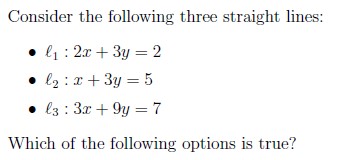
- Slopes: ℓ₁ = −2/3, ℓ₂ = −1/3, ℓ₃ = −3/9 = −1/3. So ℓ₂ and ℓ₃ are parallel (equal slopes, different lines). ℓ₁ is not parallel to ℓ₂, and (−2/3)(−1/3) ≠ −1, so ℓ₁ and ℓ₃ are not perpendicular.
- Q6Answer: 165
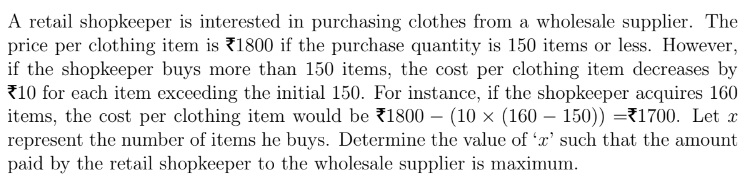
- For x > 150, price per item = 1800 − 10(x − 150) = 3300 − 10x. Amount paid = x(3300 − 10x) = −10x² + 3300x. This is a downward parabola, so the maximum is at x = 3300/20 = 165.
- Q7Answer: A, D
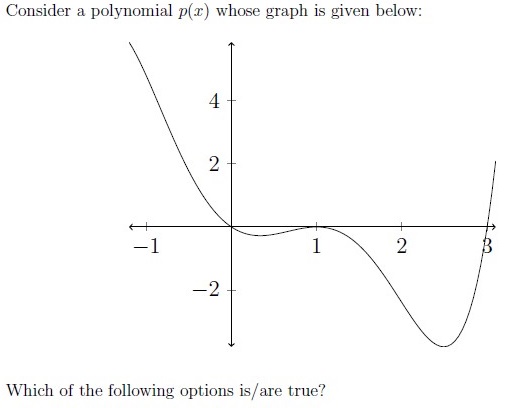
- The graph crosses the axis at 0 and 3 and touches it at 1, so root 1 has even multiplicity. Minimum degree = 1 + 2 + 1 = 4, and root 3 can have multiplicity 1. The graph crosses at x = 0, so there is no turning point there. There are 3 turning points, not 4.
- Q8Answer: B, C
- |S × S| = 4 × 4 = 16, not 4. y − 1 = (x − 2)² is y = (x − 2)² + 1, so the vertex is (2, 1). Any subset of S × S is a relation on S by definition. A line parallel to the y-axis is vertical, so its slope is undefined, not 0.
- Q9Answer: B, C
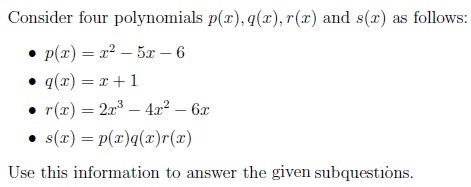
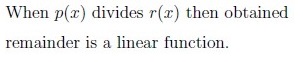
- p(x) + q(x) = x² − 4x − 5 has degree 2. p(x)r(x) has degree 2 + 3 = 5. Dividing r(x) = 2x³ − 4x² − 6x by p(x) = x² − 5x − 6 gives quotient 2x + 6 and remainder 36x + 36, which is linear.
- Q10Answer: B, D
- p(x) = (x − 6)(x + 1), q(x) = x + 1, r(x) = 2x(x − 3)(x + 1). So s(x) = 2x(x + 1)³(x − 3)(x − 6). The distinct roots are −1, 0, 3, 6 (four), root 3 has multiplicity 1, and 1 is not a root. There is one turning point in each gap (−1,0), (0,3), (3,6), so 3 turning points.
- Q11Answer: A
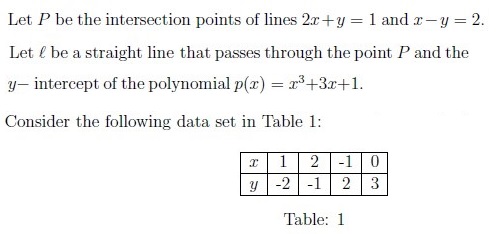
- Solve 2x + y = 1 and x − y = 2: 3x = 3, so P = (1, −1). The y-intercept of p(x) is (0, 1). Slope of ℓ = (1 − (−1))/(0 − 1) = −2. So ℓ is y = −2x + 1, i.e. 2x + y = 1.
- Q12Answer: 10
- Line ℓ is y = −2x + 1. For x = 1, 2, −1, 0 it predicts −1, −3, 3, 1. The actual y values are −2, −1, 2, 3, so the errors are 1, 2, 1, 2. SSE = 1 + 4 + 1 + 4 = 10.
- Q13Answer: A, B
- R₁ means same axis of symmetry, which works like equality, so R₁ is reflexive, symmetric and transitive. R₂ swaps b and c, and swapping again gives the first function back, so R₂ is symmetric. R₂ is not transitive: f R₂ g and g R₂ f, but f R₂ f only when b = c.
- Q14Answer: B
- R₂ sends each ax² + bx + c to exactly one function, ax² + cx + b, so R₂ is a function. It is one-one and onto, because swapping b and c again undoes it. R₁ is not a function: one quadratic has the same axis as many others.