Indian Institute of Technology Madras
BS Degree Programme · Examination & Study Paper
BSMA1001 · Mathematics for Data Science I
Qualifier · May 2024
Examination Instructions & Guidelines
- Solve on notebook/paper first before checking solutions.
- MCQ: Exactly 1 option is correct. Negative marking applies.
- MSQ: One or more options correct. Select all to score.
- NAT: Numerical response. No negative marking.
- Scientific calculator allowed for all calculations.
- Official answer key is sealed at the end of this sheet.
Read the passage below, then answer Q1–Q3
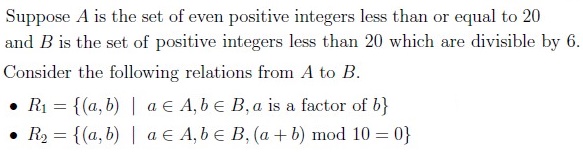 Q1NAT3 Marks·Write the number
 Your answer:
- Q2NAT2 Marks·Write the number
What is the cardinality of R₁?
Your answer: - Q3MSQ3 Marks·Choose all correct options
Which of the following statements are correct?
- AR₁ is transitive.
- BR₂ is transitive.
- CR₂ is not symmetric.
- D(2,18) is an element in R₂.
Read the passage below, then answer Q4–Q5
Suppose that P₁ and P₂ are two different points in a Cartesian coordinate system, with P₁ located at (3,−2) and P₂ at (−1, 5). Let L₁ and L₂ be lines passing through P₁ and P₂ respectively.
Q4MCQ4 Marks·Choose one option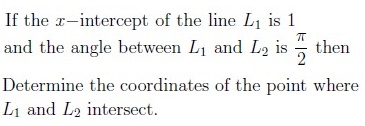
- A

- B

- C

- D

- A
- Q5MCQ4 Marks·Choose one option
If the x−intercept of the line L₁ is 1 and y− intercept of the line L₂ is -1 and If θ is the angle between L₁ and L₂, then tan θ is equal to
- A

- B

- C

- D

- A
- Q6NAT4 Marks·Write the number
A company opened recruitment for the post of data analyst. 500 candidates have applied for the post. 285 candidates are proficient in Python programming, 195 candidates are proficient in C programming, 115 candidates are proficient in Java programming, 45 candidates are proficient in Python and Java, 70 candidates are proficient in C and Python, 50 candidates are proficient in C and Java and 50 candidates don’t know any of the programming languages. Find the number of candidates who are proficient in exactly one of the three programming languages.
Your answer: - Q7NAT4 Marks·Write the number
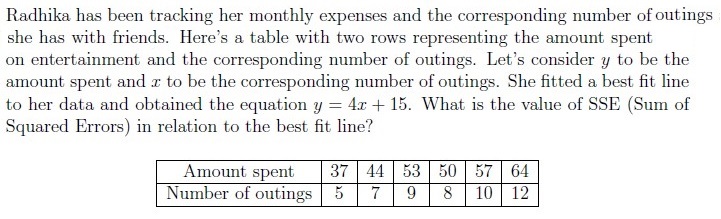 Your answer:
- Q8MSQ4 Marks·Choose all correct options
Consider the following polynomial p(x) whose graph is given below:-
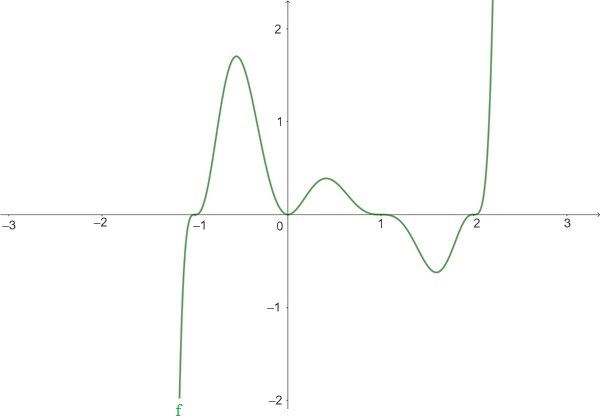 Which of the following options is/are correct?
- A

- B

- C

- D

- A
- Q9MSQ4 Marks·Choose all correct options
Consider the parabola y = x² + 4x + 12. Which of the following option(s) are true?
- AThe co-ordinates of vertex is (−8, 2).
- BThe given equation attains it minima at x = −2.
- Cy-intercept of parabola is 12.
- DThe minimum value for the given equation is 8
- Q10MSQ4 Marks·Choose all correct options

- Aq(x) is a cubic polynomial.
- Bq(x) is a quadratic polynomial.
- Cq(x) has two distinct zeros.
- Dq(x) does not have any real zeros.
- Q11MCQ4 Marks·Choose one option

- AIf b² − 4ac > 0 and a perfect square then there exists a rational root of the quadratic equation.
- BIf b² − 4ac > 0 and not a perfect square then there exists a rational root of the quadratic equation.
- CIf b² − 4ac < 0 and a perfect square then there exists a rational root of the quadratic equation.
- DIf b² − 4ac < 0 and not a perfect square then there exists a rational root of the quadratic equation.
Official KeyMaster Answer Key & Explanations
Official answer keys from IIT Madras BS past papers. Click any question to review.
Reveal KeyCollapse Key
Master Answer Key & Explanations
Official answer keys from IIT Madras BS past papers. Click any question to review.
Detailed Answer Notes & Working
- Q1Answer: 1
- A = {2, 4, …, 20} and B = {6, 12, 18}. R₂ needs a + b to end in 0, so R₂ = {(4,6), (14,6), (8,12), (18,12), (2,18), (12,18)}. Of these, only (2,18) has a as a factor of b. So R₁ ∩ R₂ = {(2,18)} and its cardinality is 1.
- Q2Answer: 9
- B = {6, 12, 18}. For b = 6, a can be 2 or 6. For b = 12, a can be 2, 4, 6 or 12. For b = 18, a can be 2, 6 or 18. So |R₁| = 2 + 4 + 3 = 9.
- Q3Answer: A, C, D
- Being a factor is transitive (a divides b and b divides c means a divides c), so R₁ is transitive. R₂ = {(4,6), (14,6), (8,12), (18,12), (2,18), (12,18)}. (2,18) and (18,12) are in R₂ but (2,12) is not, so R₂ is not transitive. (4,6) is in R₂ but (6,4) is not, so R₂ is not symmetric. 2 + 18 = 20, so (2,18) ∈ R₂.
- Q4Answer: D
- L₁ passes through (3,−2) and (1,0), so its slope is −1 and L₁ is y = −x + 1. L₂ is perpendicular, so it has slope 1 through (−1,5): y = x + 6. Solve −x + 1 = x + 6 to get x = −5/2 and y = 7/2. The point is (−5/2, 7/2).
- Q5Answer: B
- L₁ through (3,−2) and (1,0) has slope m₁ = −1. L₂ through (−1,5) and (0,−1) has slope m₂ = −6. tan θ = |(m₁ − m₂)/(1 + m₁m₂)| = |(−1 + 6)/(1 + 6)| = 5/7.
- Q6Answer: 325
- 450 people know at least one language (500 − 50). 450 = 285 + 195 + 115 − 45 − 70 − 50 + x gives x = 20 who know all three. Exactly one = (sum of singles) − 2 × (sum of pairs) + 3x = 595 − 330 + 60 = 325.
- Q7Answer: 23
- Predicted y = 4x + 15 gives 35, 43, 51, 47, 55, 63 for x = 5, 7, 9, 8, 10, 12. The actual values give errors 2, 1, 2, 3, 2, 1. SSE = 4 + 1 + 4 + 9 + 4 + 1 = 23.
- Q8Answer: B, C
- The graph crosses at −1, 1 and 2 with a flat shape, so these roots have odd multiplicity (3 or more), but they need not be equal. After x = 2 the graph goes up forever, so p(x) is increasing on (2, ∞) and p(x) → ∞ as x → ∞. There are only 4 turning points, not 5.
- Q9Answer: B, C, D
- y = x² + 4x + 12 = (x + 2)² + 8. So the vertex is (−2, 8), the minimum is at x = −2 and the minimum value is 8. At x = 0, y = 12, so the y-intercept is 12. The vertex is not (−8, 2).
- Q10Answer: B, C
- The zeros 1/2 and 5 come from (2x − 1)(x − 5). The other zeros 2 and 3/5 must come from q(x). So q(x) = k(x − 2)(5x − 3), which is a quadratic with two distinct real zeros.
- Q11Answer: A
- The roots are (−b ± √D)/2a with D = b² − 4ac. If D > 0 and D is a perfect square, √D is an integer, so both roots are rational. If D < 0 there are no real roots at all, so options C and D are false.